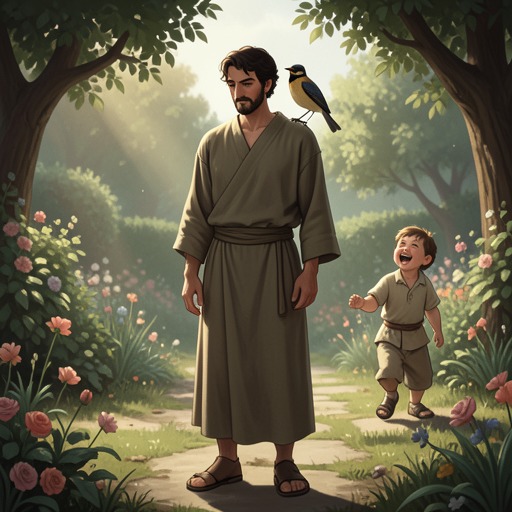
Love life before seeking its meaning
The Brothers KaramazovLove life before seeking its meaning is the principle Ivan and Alyosha explore in a conversation about whether life can still be loved when faith in its order has failed. Ivan’s answer begins in the body rather than in a proof: the desire to live may persist through disillusionment, and love of the world may precede any rational account of why it deserves love. Alyosha recognizes this longing as a beginning, not a completed reconciliation, and urges Ivan toward the further step that might save him.
The Desire to Live Despite Disillusionment
Ivan imagines the extremity of losing faith: he might cease to believe in life, lose faith in the woman he loves and in the order of things, and become convinced that existence is disorderly, damnable, and perhaps ruled by the devil. Even then, he says, he would still want to live. The thought is not offered as a solution to the world’s disorder. It marks a distinction between explaining life and being drawn toward it: intellectual conviction may fail to affirm the universe, while the impulse to go on living remains.
That impulse is associated with the Karamazovs’ thirst for life, which Ivan refuses to dismiss as base. He describes himself as longing for life and continuing to live in spite of logic. The phrasing matters: life is not first justified by a successful argument, nor does its appeal depend on confidence that the universe is rightly ordered. The desire survives precisely where rational assurance does not.
Particular Things Before Abstract Meaning
Ivan makes this persistence concrete through his love of the sticky little leaves as they open in spring and of the blue sky. He also loves certain people without knowing why, and great deeds done by human beings, though he feels that his faith in them may have long since disappeared. These attachments do not erase his bleak judgment or restore lost belief by logical means. Instead, they show that his relation to the world remains more intimate and particular than his abstract conclusions allow.
His image of a graveyard deepens the contrast. Ivan says he may be convinced in his heart that the world has long been nothing but a graveyard, yet he would not weep from despair alone: he would also be happy in his tears, steeping his soul in emotion. In this account, grief and affirmation coexist. The tears do not prove that suffering is justified or that the world is harmonious; they register an emotional participation in life that persists even under the shadow of death and disillusionment.
Ivan describes this love as inward and bodily rather than intellectual or logical, using the phrase “with one’s inside, with one’s stomach.” He includes love of the first strength of one’s youth among its objects. His language shifts the question from whether life can be defended as an idea to whether it is already felt as an attachment. The spring leaves and blue sky are not premises in a demonstration; they are instances of a world to which he remains responsive.
Alyosha’s Reply: Love Before Explanation
Alyosha tells Ivan that he understands the longing and is glad Ivan possesses it. He then states his own conviction: everyone should love life above everything in the world. When Ivan asks whether this means loving life more than its meaning, Alyosha agrees. In his view, love must come first, even when it runs counter to logic; only then can a person understand life’s meaning.
Alyosha frames the exchange as an unfinished movement. He tells Ivan that half the work is already done because Ivan loves life, and that he need only try the second half to be saved. The metaphor gives the idea its direction: the first movement is not intellectual assent but attachment to life; the next remains an effort Ivan must undertake. Alyosha’s answer is hopeful, but it does not claim that Ivan has completed that work. Ivan replies that Alyosha is trying to save him and adds that he may not be lost, leaving the question of his spiritual condition open.
The Idea’s Significance
The conversation refuses to make love of life depend on a prior resolution of the problem of suffering or the order of the universe. Ivan can hold a bleak view of the world and still love its leaves, sky, people, and human deeds; feeling is not presented as a logical rebuttal to his doubts. Alyosha instead treats this surviving attachment as the ground from which understanding might become possible. The idea therefore turns on sequence: not meaning first and love afterward, but love as a lived relation that may lead toward meaning.
The exchange also preserves the difference between the brothers. Ivan articulates an affirmation that survives his loss of faith, but his examples remain bound to pain, uncertainty, and possible despair. Alyosha receives that affirmation as hope and points toward salvation, while Ivan neither simply rejects nor fully accepts the conclusion. The principle is powerful precisely as a beginning: love of life is already present, but its meaning and its capacity to resolve Ivan’s crisis remain unsettled.